
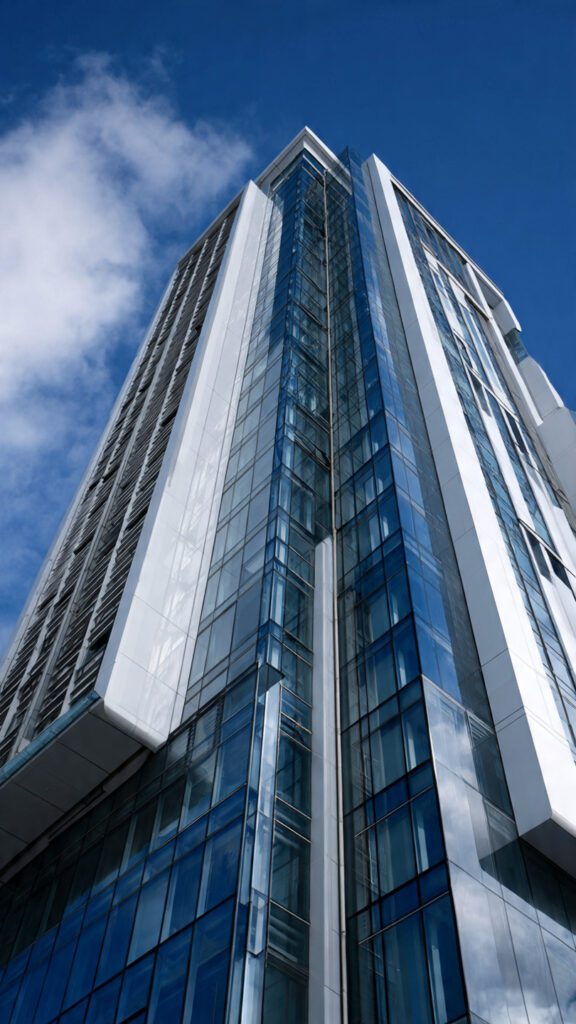
Aluminium Facade Load Requirements for High-Rise Buildings in South Africa
For Accend Aluminium & Glass (2AG) — serving Johannesburg, Roodepoort, Randburg, and surrounding areas — understanding load requirements for aluminium and glass façades is crucial. Moreover, these requirements ensure safe, compliant high-rise construction. In this post, we explore structural load requirements, focusing on wind loads, compliance with SANS 10160, and certified engineering.
SANS 10160: The Regulatory Foundation
SANS 10160 serves as South Africa’s national standard for structural design. It covers dead loads, imposed loads, thermal effects, and wind actions.
Therefore, façades, such as aluminium-glass curtain walls, are considered elements attached to the building’s main structure. Consequently, their design must integrate with the building’s overall structural engineering rather than be treated as standalone components.
For 2AG clients, this means that aluminium curtain wall systems must include full structural calculations referencing SANS 10160 before installation. This ensures both safety and legal compliance.
Wind Loads: A Critical Factor for Aluminium and Glass Façades
Why Wind Matters
High-rise façades face significant wind forces. As a result, the taller the building, the higher the wind pressure and suction. Aluminium-glass façades (also known as curtain walls) resist these forces through their framing and anchorage systems.
Failures often occur when components such as glazing, gaskets, or anchors cannot withstand these forces. Therefore, proper calculation of wind loads is essential to prevent damage or safety hazards.
SANS 10160‑3: Scope
SANS 10160‑3 (Wind Actions) applies to most high-rise buildings up to 100 meters tall or structures with natural frequency above 5 Hz.
However, it excludes extremely slender towers or super-tall skyscrapers, which require more detailed analysis. For most Johannesburg high-rises, SANS 10160‑3 provides a reliable framework for wind-load design.
Design Wind Pressure
Design wind speeds vary depending on the municipality. Johannesburg typically experiences wind speeds from 32 m/s to 44 m/s. Engineers convert these speeds into design pressures for façade components. (skyciv.com)
Additionally, both external wind pressure and suction must be considered. Internal pressure, such as through openings or vents, also influences structural performance. (scribd.com)
Serviceability and Safety
Wind-load design does not end with strength requirements. Moreover, façades must meet serviceability criteria, including deflection limits, seal integrity, water and air tightness, and occupant comfort. Many experts recommend full-scale testing of curtain-wall systems, especially for taller buildings.
Structural Design & Certification: What 2AG Clients Should Demand
When 2AG supplies aluminium-glass façades, clients can expect:
-
Certified structural calculations verifying compliance with SANS 10160.
-
Detailed wind-speed zones and resulting design pressures.
-
Frame profiles, glazing, and anchor brackets sized for wind loads, deflection limits, temperature effects, and long-term durability.
Furthermore, for taller or irregular buildings, full-scale mock-up or wind-tunnel testing validates performance under realistic wind conditions.
Since Accend Aluminium & Glass offers a broad range of façade, window, and door systems (2ag.co.za), their local experience in Roodepoort and Randburg ensures that all façade systems are fully engineered, tested, and compliant with South African standards.
Why Proper Load Compliance Matters
International studies show that many façade failures result from underestimated wind loads, insufficient anchorage, or overlooked serviceability limits. (sear.unisq.edu.au)
Consequently, relying solely on fabrication standards without engineering verification can lead to serious safety hazards. Therefore, every high-rise façade must undergo structural review, testing, and certification.
Conclusion
Aluminium-glass façades deliver sleek aesthetics, daylighting, and modern design. However, for high-rise buildings, they must also meet rigorous structural load requirements. SANS 10160, particularly Part 3 for wind actions, provides the legal and technical framework.
As a result, clients working with Accend Aluminium & Glass can ensure safety, durability, and compliance by demanding full structural calculations, proper frame and anchor sizing, and full-scale testing where necessary. Ultimately, combining architectural vision with engineering rigor ensures façades that perform beautifully — and safely.
References
-
SANS 10160‑3:2019, Basis of structural design — Part 3: Wind actions (studocu.com)
-
Accend Aluminium & Glass products and services (2ag.co.za